


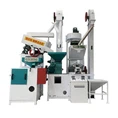


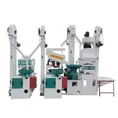
With the gradual improvement of living standards, people have put forward higher requirements for the quality of rice, which has led to the rapid improvement of rice milling technology. With the continuous improvement of rice varieties, the yield of slender and elongated rice has been increasing in recent years. During the harvesting and threshing process of this type of rice, a large number of bursting phenomena may occur due to its own reasons. Traditional rice mills, due to outdated technology, can increase the rate of broken rice. The unreasonable arrangement of components and outdated technology in traditional rice mills have led to insufficient air flow and low air pressure passing through the rice milling chamber. Grains settle at the bottom of the rice milling chamber under their own weight, resulting in poor fluidity and insufficient utilization of the existing rice milling movement area. To improve the processing quality of rice, it is necessary to use one or two machines to mill the rice and increase the pressure inside the milling chamber. However, this will cause an increase in rice temperature, and coupled with the high burst rate of the original rice, a large amount of broken rice will be produced during the milling process. Therefore, in order to reduce the rate of broken rice and improve the quality of rice, a multi machine light milling process should be adopted.
Due to the different structures and parameters of rice mills, any rice mill has one main method of rice milling, which can be divided into friction type rice mills (iron roller rice mills) and grinding type rice mills (sand roller rice mills)
There are three main types of small-scale rice milling equipment in China: separated rice milling machines, combined rice hulling and milling machines, and spray air rice milling machines.
Operation method
1. Place the rice mill steadily on the workbench and plug in the power plug.
2. Determine the whitening time and adjust the timing knob of the rice milling machine.
3. Take out the pressure from the hopper, take 17-20g of brown rice (with a moisture content not exceeding 15%) and put it into the feeding hopper, allowing it to flow into the grinding chamber. Press the power button first to start, then lower the pressure.
4. At the specified time, the rice mill will automatically stop running, take out the hopper first, and remove the bran. Insert the feeding hopper again, then remove the pressure, turn the front handle to the right °, so that the polished rice in the white milling chamber falls into the feeding hopper. Set the timing knob to 0 position, press the power button to let the grinding wheel idle for a few seconds, so that all the rice grains in the white milling chamber fall off. Then pull out the rice hopper and pass it through the screening of the rice mill to obtain the measured polished rice.
matters needing attention
1. Before entering the rice mill hopper, brown rice should be checked for metal objects and stones to avoid damaging the grinding wheel.
2. After the whitening process is completed, the front rotating block should be pulled out to clean the remaining sugar in the whitening chamber of the rice mill to avoid affecting the accuracy of the sample.
3. The whitening accuracy needs to be determined by the variety of brown rice to determine the number of samples and whitening time. For low precision samples, it is advisable to have a quantity of 17-18g, and the whitening time should be slightly shorter; 20g of high-precision samples is recommended, and the whitening time is slightly longer.
4. When the rice mill has been used for a long time and grinds brown rice with high moisture content, and the adhesion of the rice bran to the grinding wheel affects the whiteness, a wrench can be used to remove the grinding wheel, brush off the bran powder with a steel wire brush, and reinstall it as it is before continuing to use.