


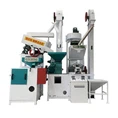



1. Hulling section
Shelling is the process of hulling rice. Mainly through the relative movement of a pair of rubber rollers with different rotational speeds, the rice is extruded and torn under a certain pressure to achieve the purpose of dehulling. Then, by utilizing the difference in suspension speed between rice and rice husks, the rice mixture is separated from the rice husks through air suction. During the shelling process, there are some cracked grains and incomplete grains in the rice, and due to the pressure between the rollers on the rice, some grains are crushed and broken.
2. Grain rough separation and lubrication section
The moisture content of brown rice before entering the rice mill can also affect the rate of broken rice. When the water content is low, the pressure required for whitening increases, inevitably increasing the amount of broken rice; Excessive moisture, loose rice texture, and decreased strength can also increase broken rice. In practice, broken rice can be reduced by tempering. The conditioning of brown rice mainly involves wetting and roughening it, which can soften the cortex, reduce the binding force between the cortex and endosperm, and lower the temperature of brown rice (usually below room temperature), thereby reducing the pressure inside the rice milling chamber and reducing the amount of broken rice produced during the milling process.
3. Rice milling section
Rice milling is the process of using a sand roller and an iron roller to mill out the rice grains, peeling off the outer layer of brown rice, in order to achieve the goal of carbon white. Although brown rice is more nutritious than rice, the cellulose content in the outer layer of brown rice is much higher than that in the endosperm, and directly cooking rice does not have a good taste, so brown rice is generally not used for cooking. Rice milling mainly utilizes the frictional force generated by the relative motion between rice grains, between rice grains and the milling roller, and between rice grains and the rice sieve, as well as the cutting effect of dense sand blades on the surface of brown rice, to achieve the effect of wiping off and smoothing the surface of brown rice.
4. Liangmi section
After several rounds of rice milling, the rice temperature will be much higher than room temperature. Entering the back polishing section without cooling will inevitably cause the rice to burst, increase the amount of broken rice, and affect the quality of the finished product. Cooling rice is to prevent it from bursting due to drastic changes in temperature and humidity, and to reduce broken rice. In addition, after the rice is cooled, the temperature of the rice during polishing is not too high, which is more suitable for starch gelatinization on the surface of the rice, forming a bright colloidal film.
5. Polishing and color selection section
Polishing is the removal of bran powder attached to the surface of white rice, making the surface smooth and improving the appearance and color of the finished rice. Its working principle is to turn water mist into tiny water droplets and attach them to the surface of white rice. By friction between the rice grains and between the rice grains and the polishing roller sieve, the goal of removing bran powder and making the white rice smooth is achieved.
6. Production process control and other links
Maintaining flow balance during the production process is an important guarantee for stable production and reducing broken rice. Because stopping the machine during the processing will produce a large amount of broken rice. There are many reasons for imbalanced flow during the production process, such as uneven raw materials, poor processing characteristics of raw materials, and lack of necessary buffer storage.