


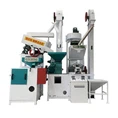


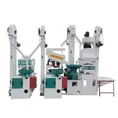
Rice is the main food product in many countries. With the development of agricultural mechanization, many machinery and equipment for processing grain are also playing a huge role in production, especially the use of rice mills, which provides great convenience for people in the process of processing rice. Especially in recent years, rice processing equipment has been widely used in rural areas, solving many problems encountered in grain harvesting, transportation, and processing, and bringing a lot of convenience. So how to choose rice processing equipment? What should I pay attention to when choosing a rice mill?
There are many types of rice mills. Therefore, when purchasing, users need to clarify the scope and conditions of use, such as whether it has a stone removal function, hourly processing capacity, hourly power consumption, and other details. This way, suitable rice mills can be purchased for convenient application.
2. When purchasing a rice mill, users must carefully inspect the quality issues of the rice mill, which can be investigated from aspects such as whether the structure of the rice mill is firm, the weight of the whole machine, and the test results. This can avoid problems during use.
Components of a complete rice mill
The complete set of rice processing equipment consists of several professional functional machines, each designed to achieve an important process, such as grain stone removal equipment, grain crusher, grain processing equipment, etc. There are various processing equipment, such as cleaning and stone removal equipment, rice milling and grinding equipment, etc. As an enterprise that wants to engage in the processing of miscellaneous grains, I didn't know at least which type of processing equipment to purchase at the beginning. Below is a brief introduction to the components of the entire rice mill.
A complete set of grain processing techniques includes grain cleaning, grain dehulling (i.e. grain separation), grain grading and screening, selective grinding of grains, and finally grain packaging.
The selection of grain screening equipment depends on the size of the sieve holes on the screen surface relative to the grain particles. For larger sieve holes, the sieve holes are slightly larger than the maximum diameter of grain particles, such as large miscellaneous sieves and cylindrical sieves; If small, the sieve hole is smaller than the minimum particle size, such as reciprocating vibrating screen, planar rotating screen, and high-speed vibrating screen.
If only engaged in food packaging, only one vacuum packaging machine is needed. Regardless of other processing equipment, there are many models of vacuum packaging machines. For a newly engaged enterprise in this industry, when the processing output is unstable, the packaging machine you choose is still relatively small.