


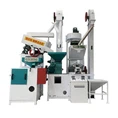


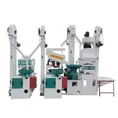
What are the main components of a self-service rice mill?
The rice milling room is the core part of the rice milling machine. The rice room has hollow shafts, sand rollers, iron rollers, rice bodies, etc. The assembly diagram of the hollow shaft, spiral head, and spindle sleeve is shown in Figure 3. The sand roller with ventilation openings is located outside the hollow shaft, and the rice body is also covered outside the sand roller. The rice body pressure frame is fixed on the rice body. The screw head is fixed at the feed end of the hollow shaft, and the spindle pressure sleeve is fixed outside the screw head. The screw head has an inlet hole 1, and the spindle pressure sleeve has an inlet hole 2. There are inlet holes 1 and 2 at both ends of the hollow shaft. This will form an entrance channel for the intermediate layer outside the hollow shaft inside the milling chamber.
The inlet 1 and inlet 2 of the rice mill form a bidirectional main shaft flow, and the inlet channel becomes a 4-channel flow. The increase in inflow and pressure in the rice chamber causes the material to hang in the air, greatly reducing the impact of gravity on the material and improving the efficiency of rice milling. The indoor pressure of polished rice gradually matches with the expansion of the air intake area. Negative pressure strong wind reduces the temperature of the rice, makes the bran more abundant, and is prone to blockage. It effectively utilizes the body area, reduces the crushing rate, and improves yield.
2. Structural diagram of sand roller and iron roller of rice mill
The sand roller and iron roller are the main working components of the milling chamber. From the schematic diagram of the sand roller structure, it can be seen that there is a fixed sleeve 24 on the inner wall of the sand roller. The sand roller and the hollow shaft are connected through the fixed sleeve, and there are ventilation holes on the fixed sleeve.
From the schematic diagram of the iron roller structure, it can be seen that there is a fixed sleeve on the inner wall of the iron roller, which is connected to the hollow shaft through the fixed sleeve, and ventilation holes are opened on the fixed sleeve.
3. The supply device of the rice mill
It consists of a hopper, supply door, top rod, lever mechanism, etc. There is an entrance at the entrance of the rack, and there is a tilted feeding door at the entrance. One end of the feeding door is fixed on the top pin and can swing up and down through the spring of the top pin. One end of the ejector pin is connected to the supply door, and the other end is connected to the lever mechanism. The other end of the leverage mechanism is connected to the lever. The other end of the pull rod is equipped with a handwheel, and the pull rod has a positioning groove. The outer cover of the pull rod has a positioning cover, and the positioning cover has a card entrance. Rotate the handwheel to control the size of the feed door opening.
4. Structural diagram of the cleaning and cooling rice device of the rice mill
The rice mill has a cold rice cleaning device for rice output, as shown in the diagram. Cleaning the cold rice device can further reduce the temperature of the rice and discharge the bran. The cold rice cleaning device consists of a bran tube, a pressure door, and a handle. One end of the bran collecting pipe is connected to the bran collecting hopper, and the other end is equipped with an open pressure door, which is controlled by the handle of the air regulating door.
The negative pressure two-way multi-channel air intake device greatly increases the entrance area and air inflow of the miller, reduces the Rice noodles ratio, saves energy, and has the characteristics of dual use of machinery. The finished rice processed by this machine has uniform precision, delicate surface, good color, and less ground rice starch.